Anthropic Merges 30,000 Changes a Day, and It Shows
Anthropic now merges over 30,000 code changes a day, up from around 2,500 in May. It says so in an engineering post…
The Qwen-Image-3.0 announcement has a giant meta name="keywords" tag in its HTML. It starts with normal Qwen and AI-product terms, then keeps going: competitor names, translated search queries, typos, and phrases from adult-content categories. It is the sort of list you expect to find in a questionable SEO spreadsheet, not attached to a polished model launch.
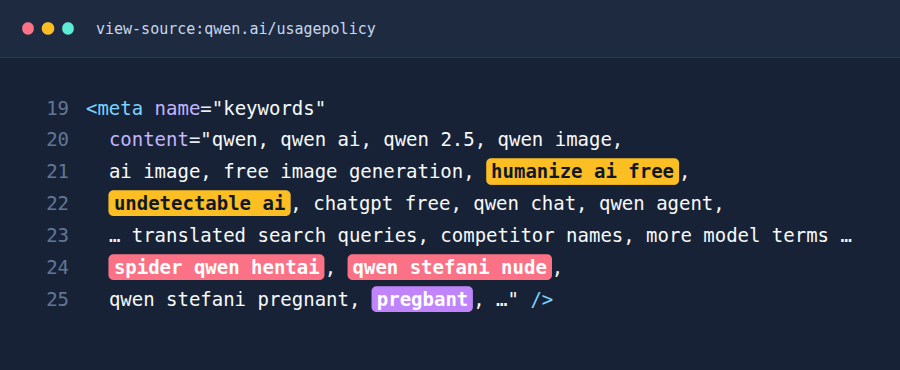
Then open Qwen's usage policy. Same giant tag. Same junk drawer.
That is what makes it funny. The page that tells users where the product's boundaries are has quietly been given a second set of labels that belongs nowhere near a policy page. The browser does not show them. The product team may never have seen them. They are still right there in the source for anyone curious enough to look.
My best explanation is speculation, not a finding about Qwen's team. It looks like somebody put a long keyword string in a shared site template and forgot it existed. Once that happens, every new page inherits the whole thing: launch posts, legal pages, probably pages with nothing to do with AI images at all. The software does exactly what it was told. The embarrassing part is that nobody was still responsible for what it was told years later.
There are plenty of ways a list like this can be born. It could be a legacy programmatic-SEO export. It could be raw query suggestions copied from a keyword tool, including the misspellings and adult searches people really type. It could be generated expansion from a broad seed term, or a third-party service with no useful filter. I do not know which one happened here. I would bet on a very mundane chain of copy-paste decisions over a deliberate plan to put bizarre search bait on a usage policy.
This is why global metadata is dangerous in such a stupid way. It arrives as one harmless-looking setting: a field in a CMS, a constant in a layout, a blob in a config file. It is too small to deserve a ticket and too invisible to show up in a screenshot. Then it is everywhere.
The page owners can do excellent work and still lose to that one field. The Qwen-Image announcement reads like a normal product announcement. The policy reads like a policy. Somewhere underneath, an old keyword blob keeps insisting that the whole site is about far more than either page says.
I would not solve this with a heroic SEO review. I would delete the global keywords field, or make it empty by default, and add one boring test that fetches the source of a policy page before release. If the same irrelevant category appears in its metadata, fail the build. That is cheaper than discovering that your public policy page has been moonlighting as an SEO landfill.
 What I'm building
Give Vroni a GitHub issue, bug report, spec, or rough idea. It reads the repo, plans the change, writes code, runs checks, and works toward a review-ready pull request.
Take a look at vroni.com